In artificial intelligence, the distributed multi-agent reasoning system (dMARS) was a platform for intelligent software agents developed at the AAII that makes uses of the belief–desire–intention software model (BDI). The design for dMARS was an extension of the intelligent agent cognitive architecture developed at SRI International called procedural reasoning system (PRS). The most recent incarnation of this framework is the JACK Intelligent Agents platform. == Overview == dMARS was an agent-oriented development and implementation environment written in C++ for building complex, distributed, time-critical systems.
Cognitive robotics
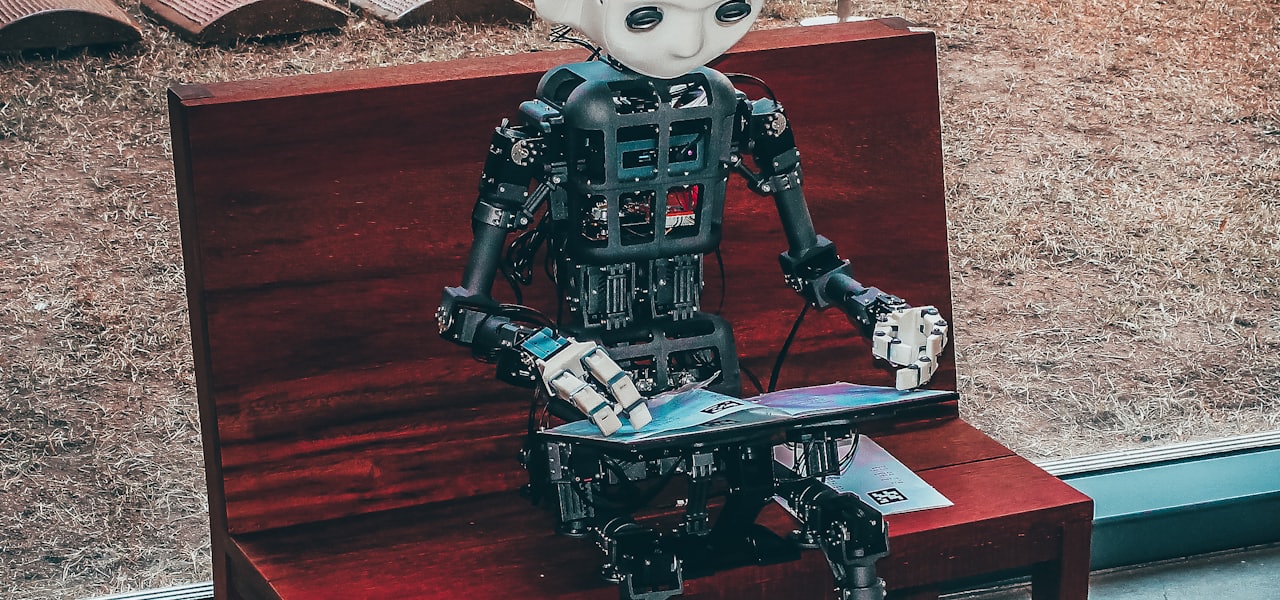
Cognitive robotics or cognitive technology is a subfield of robotics concerned with endowing a robot with intelligent behavior by providing it with a processing architecture that will allow it to learn and reason about how to behave in response to complex goals in a complex world. Cognitive robotics may be considered the engineering branch of embodied cognitive science and embodied embedded cognition, consisting of robotic process automation, artificial intelligence, machine learning, deep learning, optical character recognition, image processing, process mining, analytics, software development and system integration. == Core issues == While traditional cognitive modeling approaches have assumed symbolic coding schemes as a means for depicting the world, translating the world into these kinds of symbolic representations has proven to be problematic if not untenable. Perception and action and the notion of symbolic representation are therefore core issues to be addressed in cognitive robotics. == Starting point == Cognitive robotics views human or animal cognition as a starting point for the development of robotic information processing, as opposed to more traditional artificial intelligence techniques. Target robotic cognitive capabilities include perception processing, attention allocation, anticipation, planning, complex motor coordination, reasoning about other agents and perhaps even about their own mental states. Robotic cognition embodies the behavior of intelligent agents in the physical world (or a virtual world, in the case of simulated cognitive robotics). Ultimately, the robot must be able to act in the real world. == Learning techniques == === Motor Babble === A preliminary robot learning technique called motor babbling involves correlating pseudo-random complex motor movements by the robot with resulting visual and/or auditory feedback such that the robot may begin to expect a pattern of sensory feedback given a pattern of motor output. Desired sensory feedback may then be used to inform a motor control signal. This is thought to be analogous to how a baby learns to reach for objects or learns to produce speech sounds. For simpler robot systems, where, for instance, inverse kinematics may feasibly be used to transform anticipated feedback (desired motor result) into motor output, this step may be skipped. === Imitation === Once a robot can coordinate its motors to produce a desired result, the technique of learning by imitation may be used. The robot monitors the performance of another agent and then the robot tries to imitate that agent. It is often a challenge to transform imitation information from a complex scene into a desired motor result for the robot. Note that imitation is a high-level form of cognitive behavior and imitation is not necessarily required in a basic model of embodied animal cognition. === Knowledge acquisition === A more complex learning approach is "autonomous knowledge acquisition": the robot is left to explore the environment on its own. A system of goals and beliefs is typically assumed. A somewhat more directed mode of exploration can be achieved by "curiosity" algorithms, such as Intelligent Adaptive Curiosity or Category-Based Intrinsic Motivation. These algorithms generally involve breaking sensory input into a finite number of categories and assigning some sort of prediction system (such as an artificial neural network) to each. The prediction system keeps track of the error in its predictions over time. Reduction in prediction error is considered learning. The robot then preferentially explores categories in which it is learning (or reducing prediction error) the fastest. == Other architectures == Some researchers in cognitive robotics have tried using architectures such as (ACT-R and Soar (cognitive architecture)) as a basis of their cognitive robotics programs. These highly modular symbol-processing architectures have been used to simulate operator performance and human performance when modeling simplistic and symbolized laboratory data. The idea is to extend these architectures to handle real-world sensory input as that input continuously unfolds through time. What is needed is a way to somehow translate the world into a set of symbols and their relationships. == Questions == Some of the fundamental questions to be answered in cognitive robotics are: How much human programming should or can be involved to support the learning processes? How can one quantify progress? Some of the adopted ways are reward and punishment. But what kind of reward and what kind of punishment? In humans, when teaching a child, for example, the reward would be candy or some encouragement, and the punishment can take many forms. But what is an effective way with robots?
Gollum browser
Gollum browser is a discontinued web browser for accessing Wikipedia. Since 2017, Gollum is no longer accessible online. Gollum is designed to browse Wikipedia in an easier way than directly using the web browser. Links external to Wikipedia are opened in the user's regular browser. Gollum is opened from a regular browser and makes a window that puts the Wikipedia search bar on the toolbar. Gollum was created by Harald Hanek in 2005 using PHP and Ajax. According to one blogger, Gollum provides a way to bypass censorship of Wikipedia in China. == Languages == Though the website is available only in English and German, Gollum's GUI is available in more than 32 languages and can browse nearly 50 Wikipedia editions. === Gollum's GUI === === Browsable Wikipedia editions ===
Circular convolution
Circular convolution, also known as cyclic convolution, is a special case of periodic convolution, which is the convolution of two periodic functions that have the same period. Periodic convolution arises, for example, in the context of the discrete-time Fourier transform (DTFT). In particular, the DTFT of the product of two discrete sequences is the periodic convolution of the DTFTs of the individual sequences. And each DTFT is a periodic summation of a continuous Fourier transform function (see Discrete-time Fourier transform § Relation to Fourier Transform). Although DTFTs are usually continuous functions of frequency, the concepts of periodic and circular convolution are also directly applicable to discrete sequences of data. In that context, circular convolution plays an important role in maximizing the efficiency of a certain kind of common filtering operation. == Definitions == The periodic convolution of two T-periodic functions, h T ( t ) {\displaystyle h_{_{T}}(t)} and x T ( t ) {\displaystyle x_{_{T}}(t)} can be defined as: ∫ t o t o + T h T ( τ ) ⋅ x T ( t − τ ) d τ , {\displaystyle \int _{t_{o}}^{t_{o}+T}h_{_{T}}(\tau )\cdot x_{_{T}}(t-\tau )\,d\tau ,} where t o {\displaystyle t_{o}} is an arbitrary parameter. An alternative definition, in terms of the notation of normal linear or aperiodic convolution, follows from expressing h T ( t ) {\displaystyle h_{_{T}}(t)} and x T ( t ) {\displaystyle x_{_{T}}(t)} as periodic summations of aperiodic components h {\displaystyle h} and x {\displaystyle x} , i.e.: h T ( t ) ≜ ∑ k = − ∞ ∞ h ( t − k T ) = ∑ k = − ∞ ∞ h ( t + k T ) . {\displaystyle h_{_{T}}(t)\ \triangleq \ \sum _{k=-\infty }^{\infty }h(t-kT)=\sum _{k=-\infty }^{\infty }h(t+kT).} Then: Both forms can be called periodic convolution. The term circular convolution arises from the important special case of constraining the non-zero portions of both h {\displaystyle h} and x {\displaystyle x} to the interval [ 0 , T ] . {\displaystyle [0,T].} Then the periodic summation becomes a periodic extension, which can also be expressed as a circular function: x T ( t ) = x ( t m o d T ) , t ∈ R {\displaystyle x_{_{T}}(t)=x(t_{\mathrm {mod} \ T}),\quad t\in \mathbb {R} \,} (any real number) And the limits of integration reduce to the length of function h {\displaystyle h} : ( h ∗ x T ) ( t ) = ∫ 0 T h ( τ ) ⋅ x ( ( t − τ ) m o d T ) d τ . {\displaystyle (hx_{_{T}})(t)=\int _{0}^{T}h(\tau )\cdot x((t-\tau )_{\mathrm {mod} \ T})\ d\tau .} == Discrete sequences == Similarly, for discrete sequences, and a parameter N, we can write a circular convolution of aperiodic functions h {\displaystyle h} and x {\displaystyle x} as: ( h ∗ x N ) [ n ] ≜ ∑ m = − ∞ ∞ h [ m ] ⋅ x N [ n − m ] ⏟ ∑ k = − ∞ ∞ x [ n − m − k N ] {\displaystyle (hx_{_{N}})[n]\ \triangleq \ \sum _{m=-\infty }^{\infty }h[m]\cdot \underbrace {x_{_{N}}[n-m]} _{\sum _{k=-\infty }^{\infty }x[n-m-kN]}} This function is N-periodic. It has at most N unique values. For the special case that the non-zero extent of both x and h are ≤ N, it is reducible to matrix multiplication where the kernel of the integral transform is a circulant matrix. == Example == A case of great practical interest is illustrated in the figure. The duration of the x sequence is N (or less), and the duration of the h sequence is significantly less. Then many of the values of the circular convolution are identical to values of x∗h, which is actually the desired result when the h sequence is a finite impulse response (FIR) filter. Furthermore, the circular convolution is very efficient to compute, using a fast Fourier transform (FFT) algorithm and the circular convolution theorem. There are also methods for dealing with an x sequence that is longer than a practical value for N. The sequence is divided into segments (blocks) and processed piecewise. Then the filtered segments are carefully pieced back together. Edge effects are eliminated by overlapping either the input blocks or the output blocks. To help explain and compare the methods, we discuss them both in the context of an h sequence of length 201 and an FFT size of N = 1024. === Overlapping input blocks === This method uses a block size equal to the FFT size (1024). We describe it first in terms of normal or linear convolution. When a normal convolution is performed on each block, there are start-up and decay transients at the block edges, due to the filter latency (200-samples). Only 824 of the convolution outputs are unaffected by edge effects. The others are discarded, or simply not computed. That would cause gaps in the output if the input blocks are contiguous. The gaps are avoided by overlapping the input blocks by 200 samples. In a sense, 200 elements from each input block are "saved" and carried over to the next block. This method is referred to as overlap-save, although the method we describe next requires a similar "save" with the output samples. When an FFT is used to compute the 824 unaffected DFT samples, we don't have the option of not computing the affected samples, but the leading and trailing edge-effects are overlapped and added because of circular convolution. Consequently, the 1024-point inverse FFT (IFFT) output contains only 200 samples of edge effects (which are discarded) and the 824 unaffected samples (which are kept). To illustrate this, the fourth frame of the figure at right depicts a block that has been periodically (or "circularly") extended, and the fifth frame depicts the individual components of a linear convolution performed on the entire sequence. The edge effects are where the contributions from the extended blocks overlap the contributions from the original block. The last frame is the composite output, and the section colored green represents the unaffected portion. === Overlapping output blocks === This method is known as overlap-add. In our example, it uses contiguous input blocks of size 824 and pads each one with 200 zero-valued samples. Then it overlaps and adds the 1024-element output blocks. Nothing is discarded, but 200 values of each output block must be "saved" for the addition with the next block. Both methods advance only 824 samples per 1024-point IFFT, but overlap-save avoids the initial zero-padding and final addition.
Cloud-based quantum computing
Cloud-based quantum computing refers to the remote access of quantum computing resources—such as quantum emulators, simulators, or processors—via the internet. Cloud access enables users to develop, test, and execute quantum algorithms without the need for direct interaction with specialized hardware, facilitating broader participation in quantum software development and experimentation. In 2016, IBM launched the IBM Quantum Experience, one of the first publicly accessible quantum processors connected to the cloud. In early 2017, researchers at Rigetti Computing demonstrated programmable quantum cloud access through their software platform Forest, which included the pyQuil Python library. Since the early-2020s, cloud-based quantum computing has grown significantly, with multiple providers offering access to a variety of quantum hardware modalities, including superconducting qubits, trapped ions, neutral atoms, and photonic systems. Major platforms such as Amazon Braket, Azure Quantum, and qBraid aggregate quantum devices from hardware developers like IonQ, Rigetti Computing, QuEra, Pasqal, Oxford Quantum Circuits, and IBM Quantum. These platforms provide unified interfaces for users to write and execute quantum algorithms across diverse backends, often supporting open-source SDKs such as Qiskit, Cirq, and PennyLane. The proliferation of cloud-based access has played a key role in accelerating quantum education, algorithm research, and early-stage application development by lowering the barrier to experimentation with real quantum hardware. Cloud-based quantum computing has expanded access to quantum hardware and tools beyond traditional research laboratories. These platforms support educational initiatives, algorithm development, and early-stage commercial applications. == Applications == Cloud-based quantum computing is used across education, research, and software development, offering remote access to quantum systems without the need for on-site infrastructure. === Education === Quantum cloud platforms have become valuable tools in education, allowing students and instructors to engage with real quantum processors through user-friendly interfaces. Educators use these platforms to teach foundational concepts in quantum mechanics and quantum computing, as well as to demonstrate and implement quantum algorithms in a classroom or laboratory setting. === Scientific Research === Cloud-based access to quantum hardware has enabled researchers to conduct experiments in quantum information, test quantum algorithms, and compare quantum hardware platforms. Experiments such as testing Bell's theorem or evaluating quantum teleportation protocols have been performed on publicly available quantum processors. === Software Development and Prototyping === Developers use cloud-based platforms to prototype quantum software applications across fields such as optimization, machine learning, and chemistry. These platforms offer SDKs and APIs that integrate classical and quantum workflows, enabling experimentation with quantum algorithms in real-world or simulated environments. === Public Engagement and Games === Quantum cloud tools have also been used to create educational games and interactive applications aimed at increasing public understanding of quantum concepts. These efforts help bridge the gap between theoretical content and intuitive learning. == Existing platforms == qBraid Lab by qBraid is a cloud-based platform for quantum computing. It provides software tools for researchers and developers in quantum, as well as access to quantum hardware. qBraid provides cloud based access to Microsoft Azure Quantum and Amazon Braket devices including IQM, QuEra, Pasqal, Rigetti, IonQ, QIR simulators, Amazon Braket simulators, and the NEC Vector Annealer, as of August 2025. qBraid's base version is free, where unlimited hardware and simulator access is available with the purchase of credits. Quandela Cloud by Quandela is the platform to access first cloud-accessible European photonic quantum computer. The computer is interfaced using the Perceval scripting language, with tutorials and documentation available online for free. Xanadu Quantum Cloud by Xanadu is a platform with cloud-based access to three fully programmable photonic quantum computers. Forest by Rigetti Computing is a tool suite for cloud-based quantum computing. It includes a programming language, development tools and example algorithms. LIQUi> by Microsoft is a software architecture and tool suite for quantum computing. It includes a programming language, example optimization and scheduling algorithms, and quantum simulators. Q#, a quantum programming language by Microsoft on the .NET Framework seen as a successor to LIQUi|>. IBM Quantum Platform by IBM, providing access to quantum hardware as well as HPC simulators. These can be accessed programmatically using the Python-based Qiskit framework, or via graphical interface with the IBM Q Experience GUI. Both are based on the OpenQASM standard for representing quantum operations. There is also a tutorial and online community. Quantum in the Cloud by The University of Bristol, which consists of a quantum simulator and a four qubit optical quantum system. Quantum Playground by Google is an educational resource which features a simulator with a simple interface, and a scripting language and 3D quantum state visualization. Quantum in the Cloud is an experimental quantum cloud platform for access to a four-qubit nuclear magnetic resonance-NMRCloudQ computer, managed by Tsinghua University. Quantum Inspire by Qutech is the first platform in Europe providing cloud-based quantum computing to two hardware chips. Next to a 5-qubit transmon processor, Quantum Inspire is the first platform in the world to provide online access to a fully programmable 2-qubit electron spin quantum processor. Amazon Braket is a cloud-based quantum computing platform hosted by AWS which, as of June 2025, provides access to quantum computers built by IonQ, Rigetti, IQM, and QuEra. Braket also provides a quantum algorithm development environment and simulator. Forge by QC Ware is a cloud-based quantum computing platform that provides access to D-Wave hardware, as well as Google and IBM simulators. The platform offers a 30-day free trial, including one minute of quantum computing time. Quantum-as-a-Service by Scaleway is a cloud-based platform created in 2022 to access to real quantum hardware from IQM Quantum Computers, Alpine Quantum Technologies, Quandela and Pasqal. It also include access to GPU-powered emulators such as Aer, Qsim and Quandela proprietary emulation.
Just This Once
Just This Once is a 1993 romance novel written in the style of Jacqueline Susann by a Macintosh IIcx computer named "Hal" in collaboration with its programmer, Scott French. French reportedly spent $40,000 and 8 years developing an artificial intelligence program to analyze Susann's works and attempt to create a novel that Susann might have written. A legal dispute between the estate of Jacqueline Susann and the publisher resulted in a settlement to split the profits, and the book was referenced in several legal journal articles about copyright laws. The book had two small print runs totaling 35,000 copies, receiving mixed reviews. == Creation == The novel's creation spanned the fields of artificial intelligence, expert systems, and natural language processing. Scott French first scanned and analyzed portions of two books by Jacqueline Susann, Valley of the Dolls and Once Is Not Enough, to determine constituents of Susann's writing style, which French stated was the most difficult task. This analysis extracted several hundred components including frequency and type of sexual acts and sentence structure. "Once you're there, the writer's style emerges, part of her actual personality comes out, and the computer can be programmed to make a story." French also created several thousand rules to govern tone, plotting, scenes, and characters. The text generated by Hal, the computer, was intended to mimic what Susann might have written, although the output required significant editing. French credits Hal's work with "almost 100% of the plot, 100% of the theme and style." French estimates that he wrote 10% of the prose, the computer Hal wrote about 25% of the prose, and the remaining two-thirds was more of a collaboration between the two. A typical scenario to write a scene would involve Hal asking questions that French would answer (for example, Hal might ask about the "cattiness factor" involved in a meeting between two key female characters, and French would reply with a range of 1 to 10), and the computer would then generate a few sentences to which French would make minor edits. The process would repeat for the next few sentences until the scene was written. == Legal issues == Jacqueline Susann's publisher was skeptical of the legality of Just This Once, although French doubted that an author's thought processes could be copyrighted. Susann's estate reportedly threatened to sue Scott French but the parties settled out of court; the settlement involved splitting profits between the parties but the terms of the settlement were not disclosed. The publication of Just This Once raised questions in the legal profession concerning how copyright law applies to computer-generated works derived from an analysis of other copyrighted works, and whether the generation of such works infringes on copyright. The publications on this topic suggested that the copyright laws of the time were ill-equipped to deal with computer-generated creative works. == Reception == The book's publisher Steven Shragis of Carol Group said of the novel, "I'm not going to say this is a great literary work, but it's every bit as good as anything out in this field, and better than an awful lot." The novel received some positive early reviews. In USA Today, novelist Thomas Gifford compared Just This Once to another novel in the same genre, American Star by Jackie Collins. Gifford concluded: "If you do like this stuff, you'd be much, much better off with the one written by the computer." The Dead Jackie Susann Quarterly declared that Susann "would be proud. Lots of money, sleaze, disease, death, oral sex, tragedy and the good girl gone bad." Other reviews were mixed. Publishers Weekly wrote, "If the books of Jacqueline Susann and Harold Robbins seem formulaic, this debut novel of sin and success in Las Vegas outdoes them all. And that, in a way, is the point.... All novelty rests in the conceit of computer authorship, not in the story itself." Library Journal stated "French invested eight years and $50,000 in a scheme to use artificial intelligence to fulfill his authentic, if dubious, desire to generate a trashy novel a la Jacqueline Susann. Shallow, beautiful-people characters are flatly conceived and randomly accessed in a formulaic plot ... a sexy, boring morality tale. Of possible interest to computer buffs for its use of Expert Systems and the virtual promise of more worthy possibilities; others should read Susann." Kirkus Reviews wrote: "The deal here is that author French is not the author, he's just the midwife, having allegedly programmed his computer to write about our times just the way Susann would... almost perfectly capturing glamorous Jackie's turgid but E-Z reading prose style and ultrareliable mix of sex, glitz, dope 'n' despair.... One wonders, though, if French's tale spinning PC will do as well on the talkshows as Jackie did. The computer weenies have been trying to tell us for years, garbage in-garbage out."
Army Chief Information Officer/G-6
In September 2020, the Army realigned the previously consolidated CIO/G-6 function into two separate roles, Office of the Chief Information Officer and Deputy Chief of Staff, G-6, that report to the secretary of the Army and chief of staff of the Army, respectively. The realignment came after several months of planning and coordination. Lt. Gen. John Morrison was nominated to the Senate for promotion and assignment as the G-6 and confirmed, assuming that position in August 2020. Subsequently, the Secretary of the Army, Ryan McCarthy appointed Dr. Raj G. Iyer as the first civilian Chief Information Officer, a career Senior Executive Service position in November 2020. == G-6 == Advise chief of staff of the Army and the Chief Information Officer on planning, fielding, and execution of C4IT worldwide Army operations Develop and execute the plan for the Unified Network Implement Army information assurance Supervise C4IT, Signal support, Information security, Force structure and equipping activities in support of warfighting operations Oversee management of the Signal forces == Planned realignment == On June 11, 2020, the Army announced that the two roles of CIO and Deputy Chief of Staff, G-6 (DCS, G-6) would be realigned no later than August 31, 2020, with separate individuals responsible for each position. With the realignment: CIO core functions will be policy, governance, and oversight. Focus areas include: Information Environment, Cybersecurity, Enterprise Architecture, and Data Policy/Oversight/Governance, Enterprise Architecture, Enterprise Cloud Management and IT Spend/Category Management. DCS, G-6 core functions will be planning, strategy, and implementation. Focus areas include: Information Environment/Network, Planning and Integration, Theater Synchronization, Architecture Integration, Enterprise Information Environment (EIE) Mission Area Portfolio Management and Mission Decision Packet Management. In order to support multi-domain operations, the Army will have to connect Enterprise networks and tactical networks. —LTG Morrison, DCS, G-6 DCS G-6 released the Army Unified Network Plan under the Army Digital Transformation Strategy, to help the Army to establish a Multi-Domain Operations capable force by 2028. The Unified Network will enable Army formations, as part of the Joint Force, to operate in highly contested and congested operational environments with the speed and global range to achieve decision dominance and maintain overmatch. The plan shapes, synchronizes, integrates and governs Unified Network efforts and aligns the personnel, organizational structure and capabilities required to enable MDO at all echelons. == Chief signal officers and their successors == Chief signal officers (1860–1964) Maj. Albert J. Myer 1860–1863 Lt. Col. William J. L. Nicodemus 1863–1864 Col. Benjamin F. Fisher 1864–1866 Col. Albert J. Myer 1866–1880 (promoted to brigadier general 16 June 1880) Brig. Gen. William B. Hazen 1880–1887 Brig. Gen. Adolphus W. Greely 1887–1906 Brig. Gen. James Allen 1906–1913 Brig. Gen. George P. Scriven 1913–1917 Brig. Gen. George O. Squier 1917–1923 (promoted to major general 6 October 1917) Maj. Gen. Charles McK. Saltzman 1924–1928 Maj. Gen. George Sabin Gibbs 1928–1931 Maj. Gen. Irving J. Carr 1931–1934 Maj. Gen. James B. Allison 1935–1937 Maj. Gen. Joseph O. Mauborgne 1937–1941 Maj. Gen. Dawson Olmstead 1941–1943 Maj. Gen. Harry C. Ingles 1943–1947 Maj. Gen. Spencer B. Akin 1947–1951 Maj. Gen. George I. Back 1951–1955 Lt. Gen. James D. O’Connell 1955–1959 Maj. Gen. Ralph T. Nelson 1959–1962 Maj. Gen. Earle F. Cook 1962–1963 Maj. Gen. David Parker Gibbs 1963–1964 Chiefs of communications-electronics (1964–1967) Maj. Gen. David Parker Gibbs 1964–1966 Maj. Gen. Walter E. Lotz, Jr. 1966–1967 Assistant chiefs of staff for communications-electronics (1967–1974) Maj. Gen. Walter E. Lotz, Jr. 1967–1968 Maj. Gen. George E. Pickett 1968–1972 Lt. Gen. Thomas Rienzi 1972–1974 Directors of telecommunications and command and control (1974–1978) (a directorate of ODCSOPS) Lt. Gen. Thomas Rienzi 1974–1977 Lt. Gen. Charles R. Myer 1977–1978 Assistant chiefs of staff for automation and communications (1978–1981) Lt. Gen. Charles R. Myer 1978–1979 Maj. Gen. Clay T. Buckingham 1979–1981 Assistant deputy chiefs of staff for operations and plans (command, control, communications, and computers) (1981–1984) Maj. Gen. Clay T. Buckingham 1981–1982 Maj. Gen. James M. Rockwell 1982–1984 Assistant chiefs of staff for information management (1984–1987) Lt. Gen. David K. Doyle 1984–1986 Lt. Gen. Thurman D. Rodgers 1986–1987 Directors of information systems for command, control, communications, and computers Lt. Gen. Thurman D. Rodgers 1987–1988 Lt. Gen. Bruce R. Harris 1988–1990 Lt. Gen. Jerome B. Hilmes 1990–1992 Lt. Gen. Peter A. Kind 1992–1994 Lt. Gen. Otto J. Guenther 1995–1997 Lt. Gen. William H. Campbell Chief Information Officer, Military Deputy to the Army Acquisition Executive, and Director of Information Systems for Command, Control, Communications and Computers Lt. Gen. William H. Campbell 1997–2000